
2026 Nissan LEAF: Olathe Buyers Guide
Quick Answer: The 2026 Nissan LEAF at a Glance
The 2026 Nissan LEAF is an all-new, completely redesigned car — a coupe-styled crossover now, not the hatchback LEAF sold through 2025. Three trims: S+ from $29,990 MSRP, SV+ from $34,230, and Platinum+ from $38,990, plus a $1,545 destination charge on every trim. Every LEAF shares the same 75 kWh battery, the same 214-horsepower motor, and front-wheel drive only — there’s no AWD option at any trim. EPA range actually runs backward from what you’d expect: the base S+ goes the farthest on a charge (303 miles) and the loaded Platinum+ goes the least far (259 miles), because bigger wheels and more content add weight and drag. The other big change: DC fast charging switched from the old CHAdeMO plug to a Tesla-style NACS port, opening up a much bigger charging network than the outgoing LEAF ever had. Nissan of Olathe, on W. 117th Street, has serviced LEAF owners in this area for over a decade and stocks the new lineup now.
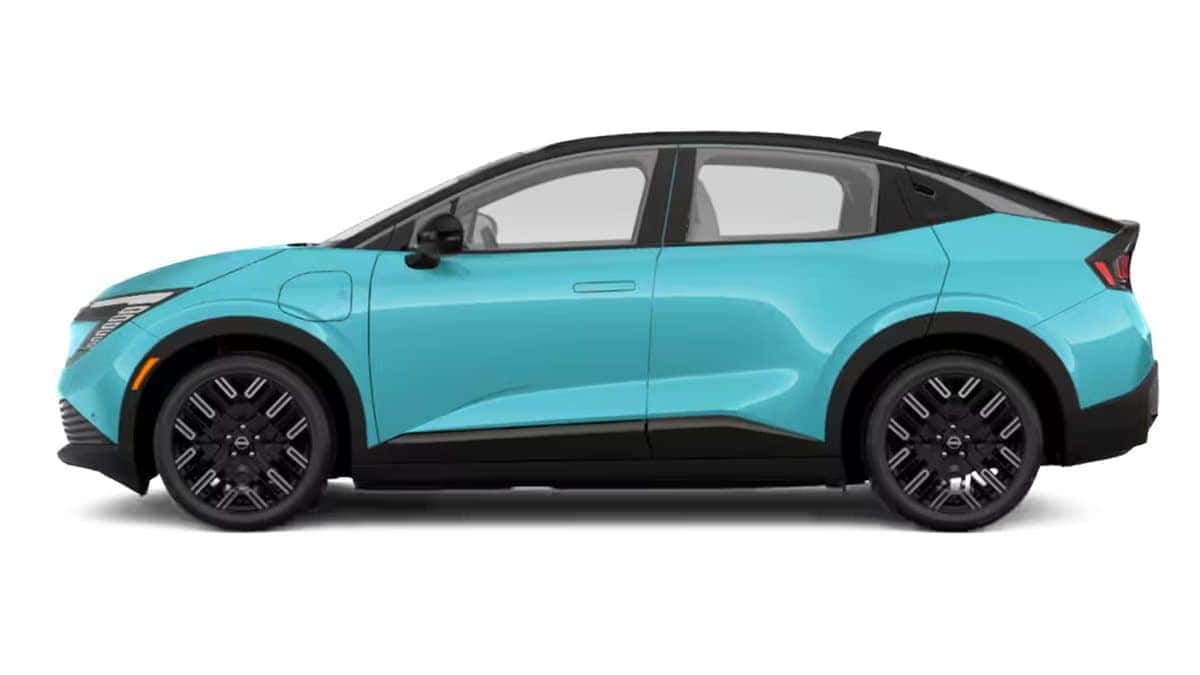
This isn’t the LEAF you remember
If the last time you thought about a Nissan LEAF it was a small, slightly awkward hatchback with a range that topped out somewhere in the low 200s, the 2026 car is going to surprise you. Nissan didn’t facelift the old LEAF — they replaced it. The new body is a coupe-styled crossover with an arching roofline and a much more aggressive stance than anything wearing the LEAF badge before it, and underneath that new shape is a genuinely different car: more range, a faster-charging architecture, and a cabin that finally looks like it belongs next to a $30,000-plus price tag instead of apologizing for one. If you’re cross-shopping and stumble on an older review describing a small hatchback with a CHAdeMO charge port and 150-ish miles of range, you’re reading about the wrong generation.
One battery, three ranges — and it runs backward from what you’d guess
Here’s the one spec that trips people up on a spec sheet: every 2026 LEAF trim uses the same physical 75 kWh battery pack. Nissan isn’t selling you a bigger or smaller battery as you move up the lineup — every trim has an identical energy budget. What changes is the wheels and the equipment, and that’s what moves the range number, in the opposite direction most buyers expect. The base S+ rides on 18-inch steel wheels, weighs the least of the three, and turns in the best EPA numbers in the lineup: 303 miles of range and 131 city / 111 highway / 121 combined MPGe. Step up to the SV+ and its 18-inch alloy wheels plus extra content — heated seats, a bigger second display, Google-based navigation — trims that down to 288 miles and 122/105/114 MPGe. Go all the way to the Platinum+ and its 19-inch wheels, panoramic roof, and heavier feature set land at 259 miles and 110/96/103 MPGe — still a genuinely usable EV range, just the shortest of the three. None of that makes the Platinum+ a worse car; it means the range column and the equipment column pull in opposite directions, and it’s worth knowing before you assume “top trim” automatically means “top range.”
Charging just got a lot less complicated
The other headline change is the charge port. Every LEAF from its 2011 debut through the outgoing 2025 model used CHAdeMO for DC fast charging — a plug standard that, especially in the last few years, showed up at a shrinking share of public fast chargers. The 2026 LEAF drops CHAdeMO entirely in favor of a Tesla-style NACS port for DC fast charging, which puts it on the same connector as a much larger and faster-growing public charging network. There’s still a separate J1772 port on the other side of the car for ordinary Level 1 or Level 2 AC charging — this is a two-port design, not a single NACS port doing double duty the way some newer EVs are built — but the DC fast-charging side is the part that actually matters for road trips, and it’s a real upgrade. Peak DC fast-charge rate is 150 kW, good for a 10-80% charge in about 35 minutes at a compatible station; a full charge on a 240V Level 2 home charger runs about 6.5 hours.

Pick your 2026 LEAF
Nissan LEAF S+
Nissan LEAF SV+
Nissan LEAF Platinum+
What buyers say about Nissan of Olathe
Nissan of Olathe carries a 4.7-star average across more than 2,800 Google reviews, and this dealership’s relationship with LEAF owners goes back years, not months. John C., describing how he got his LEAF: “James S. let us know when an electric Leaf was available, keeping us in line with a new arrival. Easy going, professional handling in all aspects of the transaction with excellent co-workers assistance.” Nathan T., on a more recent EV purchase from the same dealership: “Had a seamless experience with James in getting my second electric vehicle. He was very friendly and explained everything in more detail than I had expected… The price point was remarkable for the year and miles on the vehicle.”
Owning one in Johnson County
The LEAF service & repair guide covers what an electric car actually needs (spoiler: a lot less than a gas car), what to know about charging and battery care in Kansas weather, and the dealership’s own how-to library. Money questions — MSRP by trim, Kansas sales and property tax, the state’s new EV registration fee, and lease-versus-buy math — are in the pricing & leasing guide.
Frequently asked questions
Is Nissan discontinuing the LEAF?
No — that question shows up often in searches, but it has it backward. Nissan just launched an all-new, third-generation LEAF for 2026 with a redesigned body, a bigger effective range, and a modern NACS charging port. It’s a fresh start for the nameplate, not an ending.
How much does the 2026 Nissan LEAF cost?
MSRP starts at $29,990 for the S+, $34,230 for the SV+, and $38,990 for the Platinum+, each before the $1,545 destination charge. The pricing guide covers Kansas tax and fees on top of that.
What’s the range of the 2026 LEAF?
259 to 303 miles EPA-estimated, depending on trim — and unusually, the base S+ has the longest range in the lineup, not the shortest. See the trim-by-trim breakdown above.
What’s the downside of an EV like the LEAF, honestly?
The two real trade-offs versus a gas car: charging takes longer than a fuel stop even at a fast charger, and public charging infrastructure, while much improved with the NACS switch, still isn’t as universal as gas stations. For most local Johnson County driving with home charging, neither is a daily issue — it matters most on long road trips.
How long does a LEAF battery last?
The 2026 LEAF carries an 8-year/100,000-mile battery warranty against excess capacity loss — ask the service department for the specific coverage terms. Nissan’s LEAF platform has over a decade of real-world battery data behind it at this point, which is part of why the warranty terms are as generous as they are.
A different kind of Nissan, same dealership
The redesigned LEAF asks a genuinely different question than the gas-powered side of this dealer’s lineup — no drivetrain choice to make, a battery-and-range trade-off to understand instead of a horsepower one, and a charging routine to learn instead of a gas-station habit to keep. The trim guides below go deep on each one; Nissan of Olathe’s sales and service teams have been answering LEAF questions for a long time now.
All 2026 Nissan LEAF guides
- 2026 Nissan LEAF: Olathe Buyers Guide
- 2026 Nissan LEAF S+: Olathe Buyers Guide
- 2026 Nissan LEAF SV+: Olathe Buyers Guide
- 2026 Nissan LEAF Platinum+: Olathe Buyers Guide
- 2026 Nissan LEAF: Olathe Service & Repair Guide
- 2026 Nissan LEAF: Olathe Pricing & Leasing Guide
MSRP figures exclude the $1,545 destination and handling charge plus taxes, title, registration, and dealer-installed options; the dealer sets the actual selling price. Range and efficiency figures are EPA estimates and real-world results will vary with driving conditions, temperature, and charging habits. Equipment, trim availability, and charging specifications can change with production timing — confirm current specs and inventory with Nissan of Olathe. Customer quotes are excerpts from public Google reviews of Nissan of Olathe.